Factory Approach to Service Engineering

Service Factory

Rhema Bytes: A Factory Approach to Service Engineering
Service Factory
Service factory abstraction

When most people think of a factory, the imagery that is conjured is one of mindless repetition, and the generation of large numbers of low-value items. A good example is a nut & bolt factory. In this world, value accrues to the investors from the little profit made on each one of the millions, or billions, of items.

This does not tell the full story of factories. There is another view that most of us do not readily think of. I call this genre, a compositing factory. Good examples are found in the many custom bike shops found across the USA. Many of who arrange engines from Harley Davidson, and kit from other suppliers, into dream-machines especially tailored for their high-end clients.

Both perspectives have one thing in common. In real life, there are the designers that articulate a general template of the “thing”. And there will be the producers that directly replicate the template, or customise it before replication.  The nut & bolt represents the former (direct-replication), while the custom bike shop illustrates the latter (customised-replication). There are templates and meta-templates for both bike and nut. The nut template will be driven by permutations on materials, size and strength, whereas the bike template is a composition of an engine, frame, gears, tyres and some other bits.

In SOA architecture and design, we are also concerned with templates (ABB and SBB in TOGAF). Our templates are sometimes abstract, sometimes concrete, sometimes composite, sometimes atomic. Whether as a reference architecture, or a component design, the focus is on a template that solves a generic problem. However, most of the time, these templates are not to be replicated verbatim. Their value is almost always realised in some composition or aggregative context. Some intelligence in application being sine qua non.

For any enterprise, there will be a minimal set of services that must be realised for the organisation to be a meaningful participant in its sector. In addition to these core services, there are others that help to differentiate the organisation. These can be regarded as the macro templates. At the micro level, we find that each genre of service must complete certain tasks in order to deliver meaningful value to clients. Once again there could be differentiation by way of order, algorithm or complement, but by and by there will be a minimal set of tasks, that all must do.

If we apply the mindset of the custom bike shop to our architecture practise, we should see quite a few tools in-house that we can use/reuse. Some that can be bought, and a few that we need to fabricate. I have found that while many enterprises adopt the “reuse-buy-build, respectively” principle, not all evaluate the comparative costs of these options before making a decision. The consequence is that build, and buy, usually outnumber reuse in most organisations. In the cases where there is reuse, existing services are rendered functionally ambiguous to cater for slightly different use cases.

In a previous article, “Rhema Bytes: The Business to SOA Nexus”, it was argued that architecture should seek to create a platform of agnostic services that are well suited to serving the genre of an organisation, rather than the organisation specifically. If one were to decompose an enterprise, top-down, it should be somewhat easier to identify functionality at its most granular level. Top-down decomposition helps identify functionality at the highest level of abstraction. The analysis of each granular functional unit can help determine the comparative value of reusing, building or buying services that provide the required competence.

So, for a new business initiative that delivers services X, Y. and Z. We could ask if there is a Harley Davidson engine that fulfills that X, a Volvo axle (Y1), Saab transmission (Y2), and Toyota electrics (Y3) that deliver Y, and if a component Z5a is truly unique, or needs to be built, alongside Z1..Z3, and Z4c that do not already exist in our catalogue.

Each service, whether bought, built, or reused, is then properly catalogued as to the value it provides, its comparative costing, and what contexts it is to be used in. Such a compendium, built over time, makes it much easier to assemble solutions. Every installment of this approach makes the next assembly simpler and quicker. This is because most unique use cases/scenarios are covered off in the early solutions, and subsequent projects will reveal fewer unseen scenarios.

A lasting benefit of this mindset is that federation and outsourcing is made that much easier, since the templates for the product/service or its composition are predetermined. This means that production and assembly can be separated, and the build and testing are more effectively decoupled. In a previous article, “Rhema Bytes: SOA Services Abstraction” one such model for templating service genres in a SOA is explored. Combining this mindset with the pieces identified in that article should result in a flexible, nimble and responsive “service factory”.

Presentation: AFactoryApproachToServiceEngineering.ppt

Oyewole, Olanrewaju J (Mr.)
Internet Technologies Ltd.
lanre@net-technologies.com
www.net-technologies.com
Mobile: +44 [0] 793 920 3120
Making the best of your 9-5

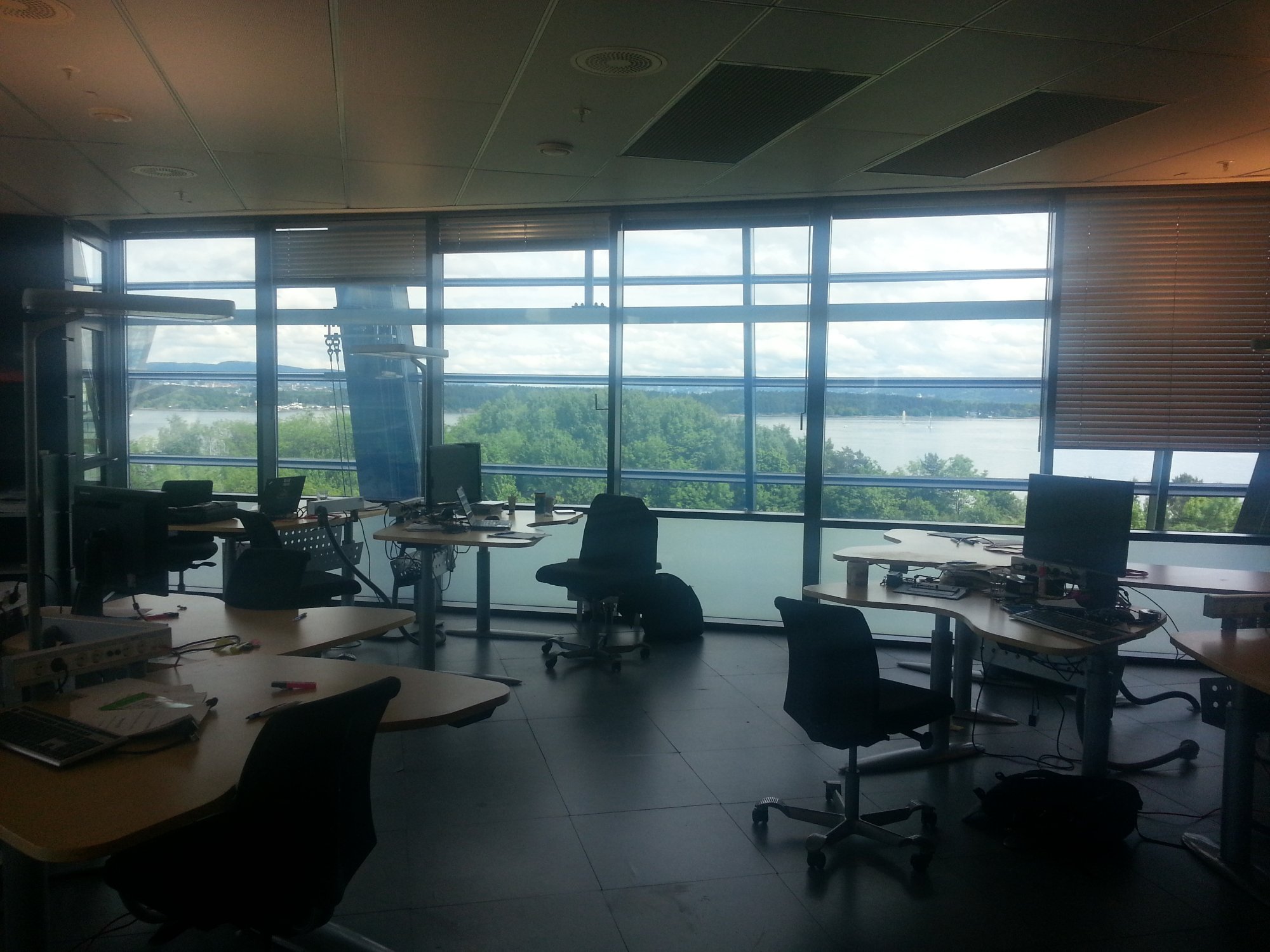
Canal Digital office in Fornebu

Work smart, not hard.Canal Digital office in Fornebu

I did a survey of the generation of my dad and his friends recently, and I made an interesting discovery. Most of the “fun” guys are still alive, but the serious and really hard working ones are all gone! I have decided not to end up like the latter group.

The vast majority of human beings spend their best years working. Work occupies most lives between the ages of 20 and 60. Work consumes the best of the waking hours of each day. Work straddles 5 out of 7 days of each week. Every working day, most adults will invest 10 hours attending to their work – about 2 hours commuting and 8 hours on the job.

Every year, we spend more time at work and with our co-workers than at home with our family, or out and about with our friends. Work environments and outcomes have a great impact on the health and life of all but the very rich, and the few contented. Work-related stress often mars the peace at home, but the brevity of the rest and comfort at home greatly limits its impact on work. Perhaps tellingly, a worker is most likely to suffer a heart attack between Sunday night and Monday morning. Wow!

So, make the best of your working life, by choosing to enjoy each working day! It is simple but profound advice; don’t ignore it. Sit comfortably; your butt is in that contraption for many hours each day. Take every opportunity to laugh. I can assure you, it is much better than crying. Laugh at your challenges, laugh at your mistakes, laugh with others as they too stumble through situations. Guess what, most of what seems monumental today, will be irrelevant in a few months, if not a few days. The crisis/catastrophe of today will be next year’s dinner joke. That is a long time waiting to enjoy a joke, especially if you will be the subject.

Don’t scrimp on lunch, you have earned it. Eat well and have a large drink, preferably non-alcoholic; it is lunch, not dinner. Try not to eat alone, you may think there is a shortage of good company and hypocrites crouch at every table. Well, dive in, one more wouldn’t hurt the mix 🙂
Thinking of something nice to nibble? Why not buy enough for a dozen. We all enjoy surprise treats, and niceness is really infectious. You may also be interested to know that it will not alter your financial trajectory. If you are going to be poor, middle-income, or rich, that extra few dollars a week or month will not break the bank. But it will make a big difference to the mood in the office.

Enjoy the environment. Don’t wait until you are in an ideal or dream premises. You may be here for a while, so try to enjoy every day of it. A stroll after eating is healthy, and it just might rein in that runaway waist. If you are up for the challenge, take the stairs rather than the lift. If you keep it up, you may have completed the equivalent of a marathon by the end of each year!

Treat your colleagues well. The opposite is like crapping in the village stream. Everyone gets sick eventually. No one likes being treated badly, and most will find a way to get even. However long it takes. Show consideration and compassion to those who struggle. It is really nice to be nice! You will feel good for it, and the beneficiaries will not forget it/you in a hurry. Payback may not come straightaway, but you will have increased the likelihood of experiencing same empathy sometime in the future.

When away from work try to shut down and enjoy life. Spend quality time with your family and friends, remember you came to work so you can maintain your family and keep up with your friends. No one goes to work to find family or to reach friends. If you drop dead tomorrow, your family will be devastated, your friends will be distraught, and your employer will find a replacement. Get your perspective right. If you were to wake up sick tomorrow, make sure that you can take consolation in a truly enjoyable yesterday.

If you don’t like your job, its time to change. Trust me, it is not worth it. Don’t be conned into “living” in the office. Work-life balance is vital. You just about make that on a 9-5, but certainly not on a 9-9. Don’t over-exaggerate your importance or the value of the task at hand, remember, this is a marathon, not a sprint. Retirement these days is granted in the latter 60s, so if you are still in your 20s to 50s, remember, you may have decades yet ahead of you. Take it easy.

Spend a few minutes reading, viewing or listening to things that delight you. Preferably things unrelated to your office work. You will feel reinvigorated after the break, and new ideas may emerge to hitherto intractable problems. Remember to get up and walk once every hour or so. It is good for your legs, bottom, and eyes. You should save yourself for retirement. You will need those arms and legs if you are to enjoy the fruit of your decades of labour.

Work smart, not hard.

I have acted to change my perspective; to work smart, not hard, and I hope to be around to enjoy a retirement. I pray you will be there too!
Have a great day, work wise!
God bless.


Oyewole, Olanrewaju J (Mr.)
Internet Technologies Ltd.
lanre@net-technologies.com
www.net-technologies.com
Mobile: +44 [0] 793 920 3120